
I’ve had quite a full stack this month. I mentioned on Instagram recently that I joined a Science Book Club at the beginning of the year, and I have been enjoying the book selections and the weekly discussions. But I’m now reading two science titles each month, so this keeps me busy!
Last month I went a little out of my comfort zone with The Allure of the Multiverse (I’ve got a science research background but NOT in theoretical physics!) but found the book and discussions fascinating.
The selected book for February and part of March was The Secret Language of Cells, and I have really enjoyed it!
The author is Jon Lieff, and each chapter takes a DEEP dive into a particular type of cell and covers all of the communication and interactions that are going on, and how each cell type accomplishes their many tasks. I have been amazed at how much I did not know! I think even in college level Biology courses students still only go so far into each kind of cell, and research has continued to expand our understanding of so many cell types, and the author covers much of these newer findings in the book. I think this book is definitely a good choice for readers with some science background, but even non-science folks with high school biology and maybe Anatomy/Physiology under their belt should be fine. And I’ve gone online looking for some background information for some topics or to go a little deeper on certain topics.
For both of these books – The Allure of the Multiverse as well as The Secret Language of Cells – I have read in my Kindle App rather than a paper copy. My initial reasoning was I wanted to access the books right away when the book club announced the selections, and I also wanted to be able to easily track any highlights in my Kindle Annotations. And as an additional help, when I am reading in the Kindle App, if there is a term I am unfamiliar with I can select and the definition is pulled up. This was a real help with The Allure of the Multiverse because I could not remember what CMBR stood for – that would be Cosmic Microwave Background Radiation which is the best evidence for the Big Bang theory. So this Kindle feature has been a real help!

For April, we have read The New World on Mars, an exciting and aspirational book about the prospect of human travel and eventual settlement on Mars. One of the things I am enjoying about this book is there is a healthy mix of energy, optimism and technical and scientific detail.
The author is doing a great job really flushing out the details of what exploration settlement and colonization will require in terms of scientific knowledge and technical capabilities and long-term considerations as far as industry lifestyle changes things like that it is easy to get swept up in the details as he lays them out and imagine how all of this is so doable and within reach and that’s exciting.
I’ve been interested in Mars colonization for a long time. I think a lot of us probably have this romantic vision of what that would look like. But this book is a great overview of what is required for this to become a reality. This is also not his only book on Mars – and topics including exploring Mars and settling on Mars – so I think that I will pursue his other titles in this area because I think he is doing a really good job going through all of the important details.
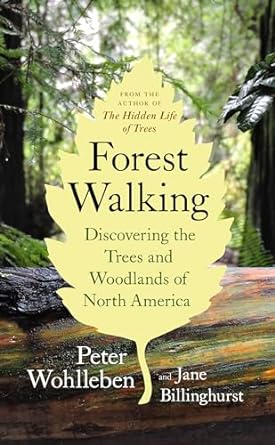
Another book I’m reading is Forest Walking, Discovering the Trees and Woodlands of North America. I love all of the books that Peter Wohlleben has written and so I’ve had this particular book on my TBR shelf for quite a while now. If you have ever read his trilogy that starts with the Hidden Life of Trees, you know that his background is in forestry and he is based in Germany. His books are written in German, but he does have an English translator and he has worked with the same translator for all of his books.
One thing that I love about this particular book is that he has co-authored this book with his English translator, Jane Billinghurst – she is based out of Oregon, I believe, and so while he is doing the writing and much of the book is from his point of view, she was very much involved in putting together this book. Even though his earlier books are very much centered around Germany and the forests he manages there, I think that his books have gotten such worldwide recognition and probably especially here in America that there was there must’ve been some push for him to write a book about trees here in North America. And so in this book he has partnered with Jane and in his same friendly conversational and accessible language he is discussing trees and woodlands here in North America, exploring them, and making them accessible to children.
He mentions throughout the book various national forest different areas around the country and so I think that this book was very much a project that he and Jane worked on it together. I am really enjoying it because while I haven’t visited all the places that he has mentioned, I have visited some. I’m also more familiar with the different regions of the continent that he is now talking about whereas in his previous books when he mentioned areas in Europe, I have a vague idea of what he is referencing, but here I am obviously more connected to the material on this book.
I am very much enjoying this book. I love his approach. I think he makes something that many people might see as mundane or not interesting and really draws our attention to and shows how trees are fascinated the animals and various plants that interact with trees going into the for all these things are so interesting and can be enjoyable by adults and children and we shouldn’t lose our connection to this aspect of a natural world and so I am loving this book.
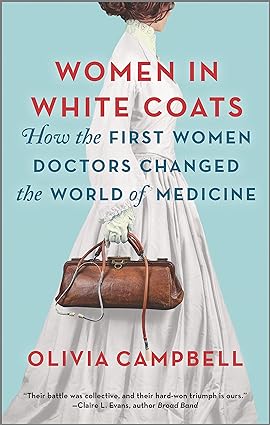
Another book I am currently reading is Women in White Coats. This book looks at how the first women to pursue medical degree degrees in this country and abroad really were treated and received. This book goes into a lot of of their experiences and the pushback (and some of the successes, to be sure) women experienced when going for any advanced degree.
I think education for women in the 1700s and 1800s was challenging, especially so in some of these more detailed areas like science or research or an or as this book covers medicine. Women were seen as suitable for nursing and so they could assist doctors, and they may be trained as midwives, but the prevailing opinion seems to have been that women were not capable of learning what they needed to learn in order to meet medical doctors. Their nature was not suitable for this kind of work, and their presence in classrooms would somehow hinder lecturing and educating upcoming medical students, because how do you discuss certain topics in the presence of ladies.
This book is equal parts inspiring and enraging. The detailed accounts of the insults and mocking and criticism and rage and anger, and even outright physical attacks is surprising, but not really. I think this is a great read, especially for women today who have pursued higher education or are pursuing it and want to go into medicine, scientific research, or any area that has had this history of gender bias. It’s a reminder that we really aren’t too far removed from this type of attitude and it takes a long time to change perceptions. I think it is important for women to read these types of stories and realize what other women have gone through to get us where we are today but also to encourage us that we still have further distance to go.
I’ll be posting my May reads as soon as possible – and my stack is pretty ambitious!
For those on the fence on whether to get an Audible membership. I have gotten a lot out of my membership over the years. There are different subscriptions available – and they also have options if you need to pause your membership. I have recently switched from the monthly membership level (a monthly fee for one credit a month) to the Audible Premium Plus Annual – the annual subscription where I get 12 credits up front and have an active Premium Plus membership for a year.
With Premium Plus, I have access to the Audible Plus catalog, which is pretty expansive. So I can listen to audiobooks without using credits. I’ve been happy with the titles available – including children’s titles. Between myself, my spouse and my kids, we really get a lot out of our membership. I’m including a link if you want to do an Audible trial – Try Audible Premium Plus and Get Up to Two Free Audiobooks.

If you are active over on Threads – I’d love to connect. I’ve just moved over there recently and have enjoyed the conversations on “Bookthreads” – you can find me posting as @michellehomescholar_books.
 Michelle Home Scholar