
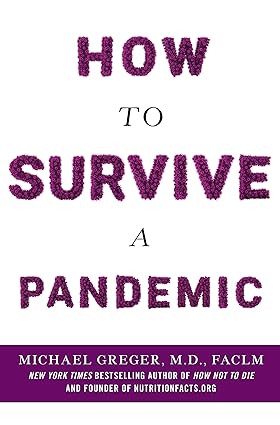
Dr. Michael Greger is a medical doctor, founder of NutritionFacts.org, and author of several books that focus on personal health and wellness.
His books include How Not to Die, How Not to Diet, and How Not to Age. In his books on health and personal wellness, he examines scientific literature worldwide and compiles the available data on nutrition, supplements, environmental and lifestyle risk-factors, our bodies’ nutritional needs, and more.
By examining all available scientific literature, he has compiled an extensive body of information about what our bodies need to maintain health.
Greger is a strong proponent of a whole foods, plant-based diet, and he has shown extensive evidence that this diet and lifestyle is the best for our health.
In the midst of the COVID-19 pandemic, Dr. Greger wrote How to Survive a Pandemic, a detailed look at the history of pandemics worldwide, as well as how they have developed and spread. He goes into detail about how viruses survive in in the wild with their natural hosts, how they make the jump to different species, and how they can mutate into a form that threatens human life.
One might expect that this book, written in the midst of the COVID-19 pandemic would focus primarily on that particular virus. And Greger does devote a portion of the book to discussing COVID-19. He discusses where the COVID-19 virus SARS-CoV-2 came from, how it developed into such a global threat, and what steps have been taken to slow the spread of the virus. He goes into the science of the SARS virus, various risk factors, as well as treatment and prevention options for individuals.
However, Greger spends a significant portion of this book looking at what he considers a much greater threat to humans worldwide – avian bird flu.
This book is history lesson, part science lesson, and part warning cry.
Greger starts off by discussing historical outbreaks that have plagued humans. He describes in detail what the 1918 Spanish Flu outbreak looked like as it spread worlwide. Greger then details the effort over several decades to conclusively identify the 1918 Spanish Flu as in fact avian influenza.
Greger does a wonderful job of explaining in easy-to-understand ways the basic virology knowledge needed to understand the difference in avian flu strains – going into detail the two types of spikes found on the surface of the virus.
Two types of spikes – hemagglutinin and neuraminidase – are enzymes found on influenza viral surfaces. There are several varieties of each of these enzymes, with eighteen hemagglutinins (H1 through H18) and eleven neuraminidases (N1 through N11), and avian flu strains are identified with which two surface enzymes are displayed on the surface. This identification system is what gives us the now-familiar identifiers, such as H5N1, with which we have become familiar.
The author goes into detail how flu virus is spread from their hosts – where they reside without harm or ill effects – into other birds and mammals. As the virus mutates and gains a foothold in new hosts, these mutations make them more virulent and able to infect non-avian species. When avian flu spreads to chickens and pigs, they continue to pick up more mutations that make them a greater risk to human populations.
As a warning cry, Greger discusses the rate in which mutations are exchanged between avian hosts when in close proximity, and he sounds the alarm on a relatively new development in human ingenuity – industrial farming. When chickens are living in less-than-ideal situations in large poultry sheds in industrial chicken farms around the world, viruses pass back and forth easily as chickens are ingesting waste and animal scraps, and spreading virus through large numbers of hosts due to crowding.
Each passage through a new host is another opportunity for mutations to occur.This particular setting for raising poultry is a fairly recent invention, and may explain why avian flu outbreaks have become more frequent and more deadly over the last several decades.
This was a well written book, clearly explaining what we have dealt with in the past as far as avian flu is concerned, why the threat posed by avian influenza has changed significantly over the past several decades, and suggestions to minimize risk.
I think Greger’s previous books could be described as promoting a particular agenda – specifically, eat a plant-based, whole food diet, making sure to get enough nutrients, for optimal health. In his previous books, he goes through macro- and micro-nutrients and details why we should or should not include in our diet.
Note – I don’t use agenda in a negative way, just that his previous books are meant as a call to action, specifically, in our personal diets.
I think How to Survive a Pandemic is different in that it isn’t “agenda” driven. The purpose of the book is to inform about the history and science of influenzas and other pandemic viruses, and how we can individually and collectively help prevent future pandemics. Greger does go into various efforts to push these large corporations that are responsible for industrial chicken and poultry farms to increase the space and ventilation available, as well as to increase cleanliness of the housing, to reduce the risk of virus spreading.
But while we can certainly vote with our wallets and support smaller poultry farms, the risk of these larger operations are still very present. If there is an agenda to this book, it is to make people aware of what is going on, and hope enough people can push for changes in practices.
Check out my 2025 Reading Plan!

If you are active over on Threads – I’d love to connect. I’ve just moved over there recently and have enjoyed the conversations on “Bookthreads” – you can find me posting as @michellehomescholar_books
** Post may contain affiliate links
 Michelle Home Scholar